The first three plumbing emergency steps for any problem
Every plumbing emergency starts with the same three steps. Stop the water, make the electricity and gas safe, then protect your belongings. Once that is done, you can work out exactly what failed.
Turn off the water
Use the shutoff valve closest to the problem. If you cannot find one, close the main water valve to the house.
Make it safe
Switch off the breaker for any wet room while standing on a dry floor. If you smell gas, go outside straight away.
Protect your belongings
Lift rugs, boxes, cords and electronics off the floor, and take a few photos before you move things.
Then call for help
Once the water has stopped, it is much easier to describe the problem clearly.
Bookmark these plumbing emergency steps now while the house is dry. If you cannot tell what kind of emergency you have, treat it as a leak. With the water stopped and the power made safe, the rest of the steps are much easier to follow.
What to do when a pipe is spraying water
Find the main water valve
Look where the water pipe enters the house. In Lubbock that is often a garage wall, a laundry closet or a box near the front hose bib.
Turn it the right way
A round handle closes clockwise and stops when it is shut. A flat lever needs a quarter turn until it lies across the pipe.
Drain the pipes
Open the tub faucet or the lowest sink in the house so the water left in the pipes drains there instead of through the leak.
Contain the water
Switch off the breakers for wet rooms, put pots under ceiling drips and use towels to stop the water spreading.
If the valve is too stiff to turn, our guide on how to turn off the main water valve explains the curb stop near the street and the smaller valves for each fixture.
What to do when sewage comes up through a drain
When dirty water comes up through the lowest drain, the main sewer line is blocked. Any water you send down a drain now will come back up.
Stop using water everywhere
Do not flush, shower, run dishes or do laundry anywhere in the house.
Close the door
Keep children and pets out of that bathroom or laundry room.
Do not use chemical drain cleaner
It cannot reach a blockage in the main line and it makes the backed up water dangerous to touch.
Protect your skin
Wear rubber gloves and boots if you have to go near it, then wash well with soap.
Our page on sewer line repair explains how the line is cleared and inspected.
What to do when a toilet is about to overflow
Close the shutoff valve
It is the small valve on the wall behind the toilet where the supply hose connects. Turn it clockwise to close it.
If the valve is stuck or missing
Lift the tank lid and hold the float up with your hand. The tank stops filling for as long as you hold it.
Do not flush again
Flushing a clogged toilet a second time is how the water ends up on the floor.
Check the tub
If the tub or shower gurgles or fills when you flush, the blockage is in the main sewer line, not the toilet.
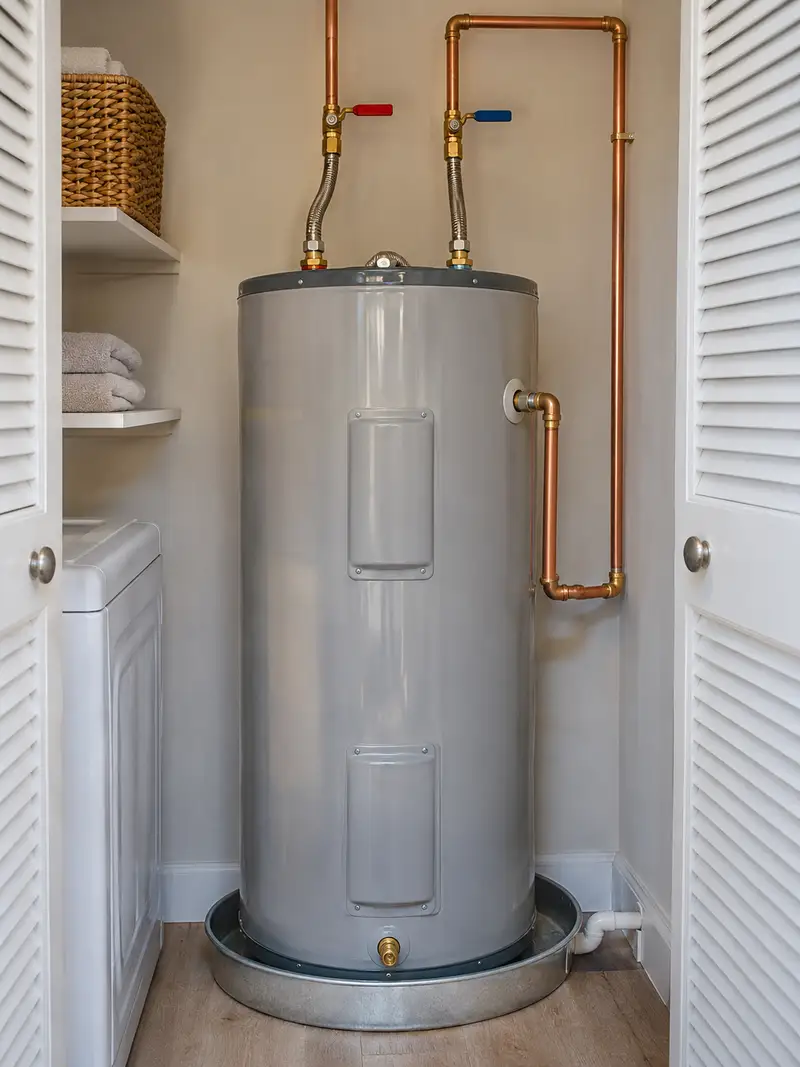
What to do when the water heater is leaking
- Close the valve on the cold water pipe that goes into the top of the tank.
- On an electric water heater, switch off its breaker. On a gas water heater, turn the control knob to pilot or off.
- Keep away from the water, because water from the tank can be scalding.
- Move boxes and anything made of cardboard out of the closet or corner.
A drip from a fitting is often a small repair. Water leaking from the tank itself almost always means the tank needs replacing. Our page on water heater repair explains the difference.
What to do if you smell gas
Get out of the house first, then call the gas company or 911 from the sidewalk or a neighbor's yard.
Do not turn any light switches on or off, keep your phone in your pocket until you are outside and do not drive a car out of an attached garage. Stay outside until someone with a gas detector says it is safe. After that, our page on gas line repair explains what happens next.
What to do when a pipe freezes
Frozen pipes during cold snaps are one of the most common reasons Lubbock homeowners need a plumber. A frozen pipe is not always cracked, and warming it slowly and evenly gives it the best chance.
- Open the faucet the pipe supplies, so melting water can flow out and pressure cannot build up.
- Warm the pipe with a hair dryer, or place a space heater a safe distance away.
- Start at the faucet end and work back toward the frozen section.
- Never use a torch, lighter or heat gun on the pipe.
- If you see water spraying, close the main water valve straight away.
Our guide on how to keep pipes from freezing explains how to prevent it next winter.
What to do when storm water comes inside
Heavy rain can overflow gutters, push water under an outside door or make a garage floor drain back up. Until the storm passes, the goal is to keep the water from spreading.
- Only go outside to clear a blocked downspout if there is no lightning and the ground is safe to walk on.
- Roll up towels and place them along the bottom of a leaking door.
- Move anything stored on the garage floor up onto shelves.
- If a floor drain bubbles up during the rain, stop using water indoors for a while.
- Treat any water touching a cord or an outlet as dangerous.
Once the storm has passed, check the ceilings, the baseboards on outside walls and the corners of the garage.
Plumbing emergencies in rentals and townhomes
If you rent, text or email your landlord as well as calling, so there is a written record, and still follow these steps yourself. Turning off the water protects your belongings as well as the building.
In a duplex or townhome, a leak can spread through the shared wall. Warn your neighbor, and tell any building manager too, because shared buildings often have a shutoff valve you cannot reach from your own home.
Common mistakes that make a plumbing emergency worse
Avoid this
- Walking through water with the power still on.
- Pouring chemical drain cleaner into a backup.
- Flushing a full toilet one more time.
- Turning the main water valve back on to see if the leak stopped.
- Heating a frozen pipe with a flame.
Do this instead
- Switch off the breakers from a dry spot, or stay out of the room.
- Stop all water use until the sewer line is cleared.
- Close the shutoff valve behind the toilet.
- Keep the main water valve closed until the repair is finished.
- Warm the pipe gently with the faucet open.
What to photograph and what to tell the plumber
Before you start cleaning up, take photos. Pictures and a short video help with an insurance claim, and they help you remember what happened and when.
- Where the problem started, such as a cracked fitting, a wet water heater base or a drain full of water.
- Each affected room, with one wide photo from the door and one close up.
- Anything damaged, with a rough list as you go.
- The time you noticed the problem and the time you turned off the water.
Details that help the plumber
| Tell the plumber | Why it helps |
|---|---|
| Where the problem is and what it looks like | It shows whether it is a pipe leak, a drain clog or a water heater failure. |
| Roughly when it started | It tells the plumber how far the water may have spread into the walls. |
| Every step you have already taken | Valve closed, breaker off or water heater on pilot, so nobody undoes it. |
| How many fixtures are affected | One fixture points to a single clog, and several point to the main line. |
| Your ZIP code | So we can confirm your address is in Lubbock. |
How to prepare before an emergency
These plumbing emergency steps work best if you have practiced them. On a quiet day, walk around the house. Turn the main water valve once, find the cold water valve on the water heater, give each sink and toilet shutoff valve a turn, and keep a flashlight, old towels and a bucket where you can find them in the dark.
Plumbing emergency questions
Where is the main water valve?
Follow the water pipe to where it enters the house. A garage wall, the laundry closet and the wall near the front hose bib are the usual places. There is also a curb stop in the meter box near the street.
What if the main water valve will not turn?
Never lever it with a long bar, because an old valve can snap. Close the curb stop with a meter key, or close the shutoff valve at the fixture that is leaking.
Should I turn off the water heater when the water is off?
If the water will be off for hours, set the water heater to vacation or pilot so it does not keep heating a tank that may be draining.
Can we stay in the house during a leak?
If the water is clean and the power is safe, most families stay. Sewage in the house or any smell of gas is different, so keep away or go outside.
My toilet is about to overflow. How do I stop it?
Close the shutoff valve behind the toilet, or hold the float in the tank up so it cannot refill. Then do not flush again.
What should I do if water is near the breaker panel?
Never touch the panel with wet feet. Keep your distance and mention it when you call, so the electrical danger is dealt with first.
Is it safe to thaw a frozen pipe myself?
Yes, if you take your time. Open the faucet first, then aim a hair dryer at the pipe or set a space heater a few feet from it. Never use a flame.
How soon should I contact my insurance company?
Most people contact them the same day. Take photos first and write down what you did and when.
What will the plumber ask me?
Where the problem is, how long it has been happening, which fixtures are affected and what you have already turned off.
What should I do if the ceiling is sagging with water?
Turn off that room's breaker, keep people from standing beneath it and set a bucket under the lowest point.
Can I flush the toilet with the water turned off?
Pour a bucket of water straight into the bowl and it will flush once. Do not do this if any drain is backing up.
What should be in a plumbing emergency kit?
A flashlight, old towels, a bucket, rubber gloves, a wet vacuum if you own one, and a card listing where every shutoff valve is.
What should I do if an upstairs neighbor is leaking into my home?
Tell them and the building manager quickly so their water can be turned off. In the meantime, move your belongings, cut the power to any wet room and take pictures.
Who else might I need besides a plumber?
For a gas smell, the gas company comes first. A water damage company helps when floors and walls are soaked, and a cleaning company handles sewage in carpet.
Can a leaking water heater wait until morning?
If the cold water valve is closed, the heat is off and the dripping has stopped, it usually can. A tank still leaking water needs help sooner.
The leak is outside. Which valve should I close?
For a leak on the stretch between the meter and the house, close the curb stop. For a leak beyond the main water valve, closing that valve is enough.
Should I move furniture out of a wet room?
Move what you can carry safely, starting with electronics, rugs and anything made of fabric or paper. Put foil or wood blocks under the legs of heavy furniture.
How do I know the water is really off?
With the main water valve closed and a low faucet open, the flow should slow to nothing. If it keeps running, the leak may be on the street side of your valve.
What if the leaking water is hot?
It is almost always the water heater or a hot water pipe. Close the cold water valve on the water heater, turn off its heat and let the water cool before you clean up.
Is it safe to use a wet vacuum on the water?
On clean water, yes, as long as the breakers for that room are off and the cord stays dry. Never use it on sewage.
Should I open the windows?
For a clean water leak, fresh air and fans help the drying once the water has stopped. For sewage, keep that room closed and only open a window you can reach without stepping in it.
How soon should drying start?
As soon as the water is off and the room is safe. Drywall, carpet pad and wood framing are much easier to save in the first day or two.